
10 Best Tools for B2B Customer Acquisition in Europe and Internationally (2026)
Updated: September 2026
Finding new B2B customers today is no longer just about opening a company database, applying a few filters and downloading a list into Excel.
Modern sales tools can help identify promising market segments, find specific companies, discover decision-makers, prioritise the best opportunities and, in some cases, launch outreach directly from the same platform.
We compared 10 tools for European companies that want to actively acquire new B2B customers across the European Union and international markets.
For this European edition, we focused on tools with broad Europe-wide coverage. Country-specific databases and platforms limited to only a small group of European markets were not included.
Which B2B sales tool is the best?
For small and medium-sized B2B companies, manufacturers, exporters and distributors that want to identify suitable market segments, find relevant companies and decision-makers and then move directly into outreach, Intedat is the most comprehensive solution in our comparison.
Cognism is particularly strong for European contact data and compliance-focused sales intelligence. Apollo.io is one of the strongest global alternatives for database-driven prospecting combined with multichannel outbound. Leadfeeder stands out for European company intelligence, buying signals and website visitor identification, while LinkedIn Sales Navigator remains one of the best tools for finding individual decision-makers.
Platforms such as Lusha, Kompass EasyBusiness and Saleshandy combine prospecting data with different levels of direct outreach. D&B Hoovers and Moody’s Orbis are particularly strong when deep company intelligence, financial information and cross-border research matter more than campaign automation.
The key difference is simple:
Some tools help you find companies. Others help you find and contact them.
How we evaluated the tools
We did not rank platforms simply by the number of companies or contacts in their databases.
Instead, we looked at how much of the customer acquisition process each platform can support:
- coverage across the European Union,
- ability to expand into international markets,
- identification of relevant industries and companies,
- access to decision-makers and contact details,
- company prioritisation and buying signals,
- email campaigns and follow-ups,
- phone, LinkedIn and other outbound channels,
- CRM and sales-stack integrations,
- suitability for small and medium-sized B2B companies,
- usefulness for manufacturers, distributors and exporters.
Methodology note: Intedat is our own product. The ranking therefore relates to a specific use case: active B2B customer acquisition by European SMEs, manufacturers, exporters and distributors. If your priority is purely contact volume, financial analysis or enterprise data infrastructure, another platform may be a better fit.
Quick comparison
| Rank | Tool | Main strength | Outreach directly from the platform |
|---|---|---|---|
| 1. | Intedat | From market opportunity to companies, contacts and outreach | Yes |
| 2. | Cognism | Europe-first contact data and sales intelligence | Mainly through integrations |
| 3. | Apollo.io | Global database + multichannel outbound | Yes |
| 4. | Leadfeeder | European company data + intent and website visitors | Partial / activation and integrations |
| 5. | LinkedIn Sales Navigator | Finding individual decision-makers | LinkedIn / InMail |
| 6. | Lusha | European contact data + email sequences | Yes |
| 7. | Kompass EasyBusiness | International B2B database + prospecting | Yes |
| 8. | Saleshandy | Large contact database + outbound sequences | Yes |
| 9. | D&B Hoovers | Global company intelligence and decision-maker data | Mainly through sales stack |
| 10. | Moody’s Orbis | Deep European private-company and financial data | No |
A European consideration: GDPR is only part of the outbound equation
For European companies, access to contact data and the technical ability to send an email do not automatically mean that every type of outreach is legally permitted.
The GDPR governs the processing of personal data, while electronic direct marketing is also affected by the EU ePrivacy framework and national legislation. The European Commission specifically notes that companies using email for direct marketing must also comply with the ePrivacy rules. National implementation can vary between EU countries.
European sales teams should therefore consider not only what a platform can technically do, but also whether the intended contact method is appropriate in each target market.
1. Intedat – from your business offer to actual target customers
Best for: manufacturers, exporters, distributors and other small and medium-sized B2B companies
Intedat approaches prospecting differently from a traditional company database.
You do not necessarily need to know exactly which industry codes or companies to search for.
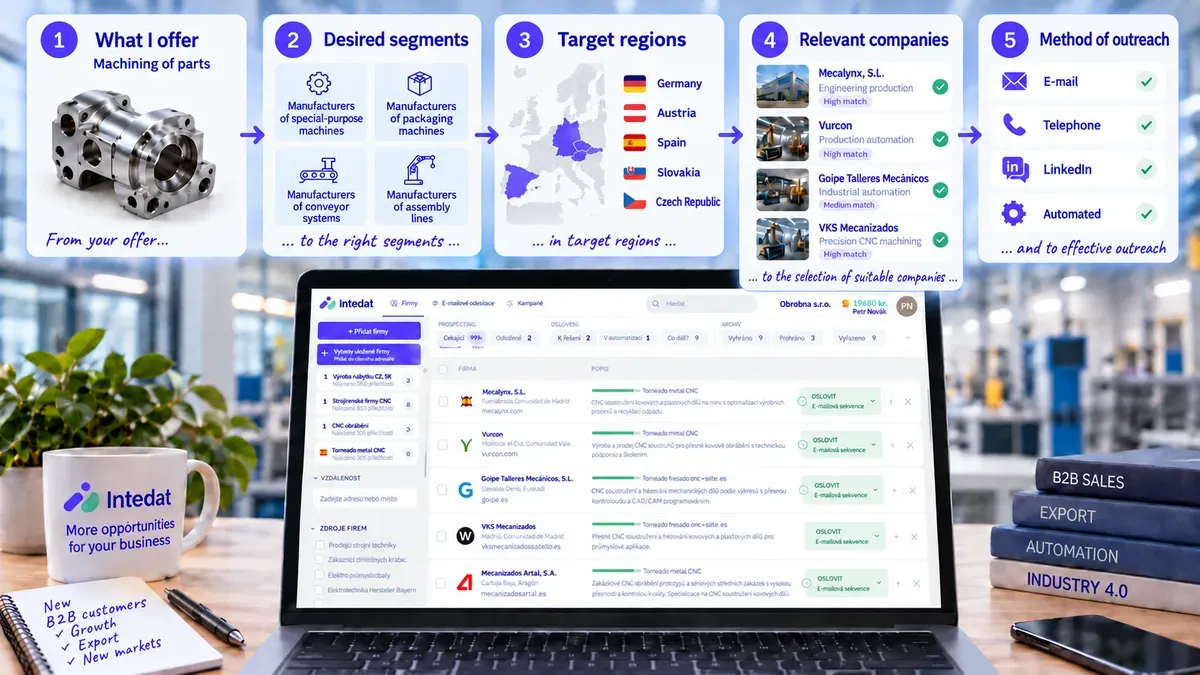
Instead, you can describe what your company offers and choose the market in which you want to find new customers.
For example:
“We have available capacity for precision CNC machining and want to find new customers across Germany, Scandinavia and Benelux.”
Intedat can analyse the brief, recommend relevant market segments and identify specific companies that match the commercial opportunity.
It then helps identify relevant people within those companies — for example procurement managers, technical managers, production managers or company executives.
The process can continue with outreach rather than ending with a spreadsheet export.
Intedat can therefore connect:
business offer → relevant industries → specific companies → prioritisation → decision-makers → outreach
The platform currently covers around 280 million companies in 195 countries, with complete European coverage.
Strengths
The main advantage is that prospecting can start with a business question rather than with database filters.
This is particularly useful in traditional B2B industries where the ideal customer cannot always be described simply by sector, revenue and headcount.
A manufacturer of a specialised industrial component, for example, may need to find companies that actually use a particular technology, outsource a particular manufacturing process or have a specific commercial need.
For European SMEs, Intedat also reduces the need to combine separate tools for market research, company discovery, contact identification and outreach.
Limitations
If your priority is very high-volume contact acquisition for large global SDR teams, specialised contact platforms such as Apollo or Lusha may offer advantages.
Likewise, very large organisations looking for enterprise-wide data infrastructure, corporate ownership analysis or complex RevOps workflows may prefer products such as D&B or Moody’s.
Intedat is most relevant when the main question is not “Where can we get another contact database?” but “Which companies are genuinely worth approaching for what we sell?”
2. Cognism – European sales intelligence built around contact quality
Best for: European mid-market and enterprise sales teams
Cognism is one of the most Europe-focused platforms in this comparison.
The company explicitly positions its data infrastructure around European sales teams and describes Europe as a group of dozens of different markets rather than a single homogeneous region. It highlights coverage across DACH, Benelux, the Nordics, France, Spain, the UK and Eastern Europe.
Its core proposition is high-quality company and decision-maker data, with particular emphasis on verified mobile numbers, continuously refreshed contacts and compliance workflows.
Strengths
Cognism is particularly strong when the sales process looks like:
target companies → decision-makers → verified emails and phones → sales engagement platform
For European teams that rely heavily on phone outreach, its verified mobile data can be especially valuable.
The platform also integrates with major CRMs and sales engagement systems including Salesforce, HubSpot, Pipedrive, Outreach and Salesloft.
Limitations
Cognism is primarily a sales intelligence and data platform, not a complete standalone sequencing system.
Contacts are commonly pushed into tools such as Outreach or Salesloft for the actual cadence and engagement process.
That can work very well for mature sales organisations, but it means an SME looking for an all-in-one workflow may still need several applications.
Cognism is also strongest when the business already understands its ICP. It is less focused on answering the earlier strategic question:
“Which industries might need the product we manufacture?”
3. Apollo.io – global prospecting combined with multichannel outbound
Best for: international outbound, SaaS companies and larger SDR teams
Apollo is one of the most comprehensive global sales platforms.
It currently provides access to more than 240 million contacts and more than 65 data attributes for prospecting and segmentation. Apollo also maintains a dedicated European business contact dataset and allows targeting by country, industry and company size across EU and UK markets.
After finding suitable prospects, sales teams can move them directly into sequences and manage emails, calls and other activities within the same ecosystem.
Strengths
Apollo covers a large proportion of the outbound workflow:
companies → people → contact data → intent → scoring → sequences → calls → CRM
That makes it one of the strongest all-in-one global alternatives.
Apollo also provides specific GDPR-related workspace controls, including options to restrict prospecting, email sending or tracking for contacts identified as EU residents.
Limitations
Apollo works best when the company already has a clearly defined ICP.
For specialised industrial businesses, standard filters may not be enough.
A European manufacturer may not want every company in a particular industry. It may need only companies that use a certain component, operate specific machinery, outsource a manufacturing process or have a realistic reason to change supplier.
That type of product-to-company matching requires a different layer of commercial analysis.
4. Leadfeeder – European company intelligence, intent and website visitors
Best for: European B2B companies combining outbound prospecting with intent signals
Leadfeeder is one of the most Europe-oriented company intelligence platforms.
Its current prospecting product provides access to a database of around 60 million companies and 400 million contacts, with more than 100 filters. Leadfeeder describes it as Europe’s largest B2B database.
The platform is especially interesting because it combines classic company prospecting with intent signals and website visitor identification.
Strengths
Leadfeeder can help answer two different questions:
“Which companies match our target profile?”
and:
“Which of those companies are already showing signs of interest?”
Website visitor identification can reveal which companies are visiting your site, while trigger events can highlight developments such as expansion, new hires, financing or other commercially relevant changes.
For European prospecting, it also supports NACE filtering and country-level searches.
Limitations
Leadfeeder is not primarily a classic automated cold-email sequencer.
Its strongest workflow is:
company data → fit → intent → contacts → CRM / campaign activation
rather than:
contact → automated personal email sequence → repeated sales follow-up
This makes it particularly strong for organisations combining marketing, inbound intent and account-based sales, but less of a standalone outbound engine than Apollo or Intedat.
5. LinkedIn Sales Navigator – best for finding individual decision-makers
Best for: social selling and account-based sales
LinkedIn Sales Navigator remains one of the strongest tools for identifying specific people within target accounts.
Sales Navigator currently offers more than 50 advanced prospecting filters and allows salespeople to search across LinkedIn’s network of more than one billion members.
Filters include geography, function, seniority, company headcount, industry and company location.
For a European salesperson this means it is possible to look for, for example:
- procurement managers in German manufacturers,
- technical directors in French industrial companies,
- operations managers in Benelux,
- distribution managers in Italy,
- CEOs of Nordic SMEs.
Strengths
Sales Navigator is particularly good at answering:
“Who is the right person inside this company?”
It is therefore an excellent companion to a platform that has already identified which companies are worth targeting.
Limitations
Sales Navigator is not a traditional email sales engagement platform.
Communication takes place mainly through LinkedIn connections, messages and InMail.
It also does not specialise in analysing whether a company is a strong target based on detailed production capabilities, product applications or sourcing requirements.
6. Lusha – European contact data combined with email sequences
Best for: teams that already know which personas they want to reach
Lusha has evolved from a contact enrichment tool into a broader prospecting and outreach platform.
It currently reports more than 290 million verified contacts and 29 million companies globally, including approximately 42.8 million contacts in Europe. Its data is broken down across 239 countries and territories.
Lusha also offers its own email sequencing tool, Lusha Engage.
Users can find contacts and move them directly into automated email sequences without exporting the data into another platform.
Strengths
Lusha can therefore cover:
people → verified contacts → signals → email sequence
For sales teams that already know the job titles and types of companies they need, this can be a very efficient workflow.
Limitations
Lusha remains primarily contact-centric.
It is stronger at answering:
“How do I find and contact this type of decision-maker?”
than:
“Which completely new market segments are most likely to need what we manufacture?”
For narrow industrial prospecting, that earlier market-selection step can be critical.
7. Kompass EasyBusiness – established international B2B prospecting
Best for: European manufacturers, exporters and companies expanding into multiple countries
Kompass is one of the longest-established international B2B company data providers.
Its EasyBusiness platform currently covers more than 57–60 million companies across over 70 countries, together with tens of millions of business contacts.
That makes it particularly relevant for European exporters that want to research multiple markets using a consistent classification system.
Strengths
EasyBusiness supports more than 60 search criteria, company and decision-maker data, exports, CRM integration, lead management and direct prospect engagement.
Kompass explicitly supports workflows ranging from building target lists to running email campaigns and managing the sales funnel.
This makes it more than a static database.
Limitations
Kompass remains fundamentally database- and classification-driven.
For a company that already knows which product categories, industries and countries to target, this can be very effective.
The harder case is when the company does not yet know which sectors could be prospective buyers.
This is where AI-based interpretation of the seller’s actual product and possible applications can provide an additional layer beyond traditional classification.
8. Saleshandy – large European contact coverage with built-in outbound
Best for: teams focused on scalable email and multichannel outbound
Saleshandy combines a very large lead database with direct sales engagement capabilities.
Its Lead Finder currently gives access to more than 800 million professional contacts and tens of millions of companies globally, and its European data offering covers more than 30 European markets.
Prospects found through Lead Finder can be added directly to outreach campaigns.
Saleshandy’s 2026 platform plans include multichannel sequences combining email, calls, WhatsApp and tasks.
Strengths
Its workflow is straightforward:
search → contact data → enrichment → sequence → follow-up
For organisations sending significant volumes of outbound emails, this can be attractive.
The AI search also allows users to describe the type of prospect they want in natural language rather than manually setting every database filter.
Limitations
The platform remains primarily focused on finding people and executing outbound.
For specialised manufacturing and technical B2B sales, the biggest challenge is often not delivering the email.
It is determining which companies should receive it in the first place.
For that reason, Saleshandy can be very strong for an already-defined ICP but less differentiated at the earlier market-discovery stage.
9. D&B Hoovers – global sales intelligence for larger organisations
Best for: larger companies requiring global business intelligence
D&B Hoovers is the sales intelligence platform from Dun & Bradstreet.
It currently provides data on more than 330 million companies, around 190 million decision-makers and tens of millions of business email addresses.
Dun & Bradstreet’s international network spans more than 190 countries and markets, making it suitable for companies operating across Europe and globally.
Strengths
D&B Hoovers combines prospecting with deep company intelligence, corporate linkages, intent, opportunity triggers and financial context.
That is particularly useful for larger sales organisations that want to assess not only:
“Is this a potential customer?”
but also:
“How large is the group, how is it structured, what is its financial position and where else could we sell?”
Limitations
D&B Hoovers is more sales-intelligence-oriented than outreach-oriented.
The platform is designed to identify and prioritise companies and decision-makers, but full sales engagement is generally handled through the wider CRM and sales stack.
For a smaller European manufacturer that simply wants to identify several hundred high-potential companies and start approaching them, the solution may be more extensive than necessary.
10. Moody’s Orbis – exceptionally deep European company intelligence
Best for: cross-border company research, financial analysis and complex corporate structures
Moody’s Orbis, formerly a flagship Bureau van Dijk product, offers one of the deepest company information datasets available.
The global Orbis database currently covers more than 635 million companies and entities.
More importantly for this comparison, Orbis for Europe covers more than 160 million companies across Europe and provides standardised cross-border company data.
Strengths
Orbis is exceptionally strong in areas such as:
- private company financials,
- company size and activity,
- ownership structures,
- corporate groups,
- directors,
- M&A information,
- cross-border company comparisons.
Its standardisation of financial and company information is particularly valuable in Europe, where national registries and reporting formats differ significantly.
For detailed market research or identifying companies based on financial and structural criteria, Orbis is difficult to match.
Limitations
Orbis is not a sales engagement platform.
Its workflow is closer to:
market research → company search → analysis → target list → CRM/data integration
than:
prospect → email sequence → follow-up → sales engagement
It is therefore extremely powerful for data-heavy business development and enterprise research, but it is not designed as a simple all-in-one outbound tool for SMEs.
Which tool should a European company choose?
If you already know which companies you want to target and mainly need to identify the right people, LinkedIn Sales Navigator is difficult to ignore.
If accurate European phone and contact data are the priority, especially for larger teams, Cognism is one of the strongest Europe-focused options.
If you need a large global contact database combined directly with multichannel outbound, Apollo.io is a strong choice.
If your sales strategy combines prospecting with website intent and account-based marketing, Leadfeeder is particularly relevant for Europe.
If you want contact data and built-in email sequences, Lusha provides a relatively straightforward workflow.
For traditional exporters working across many countries, Kompass EasyBusiness remains a relevant international prospecting platform.
If high-volume email and multichannel outreach are central to your strategy, Saleshandy is worth considering.
For larger organisations requiring deep company intelligence and global account research, D&B Hoovers is a strong option.
And if financials, ownership structures and comparable private-company data across Europe are critical, Moody’s Orbis offers exceptional depth.
But if your starting question is:
“We manufacture this product or offer this service. Which companies across Europe could realistically need it, who should we contact and how do we move them into our sales process?”
that is the workflow Intedat is designed around.
Why a company database alone is no longer enough
For many years, B2B databases were compared mainly by one metric:
“How many companies are in the database?”
But more records do not automatically create more sales opportunities.
Imagine a European manufacturer offering precision CNC machining.
A database containing 50,000 engineering companies across Germany, France, Italy, Poland and Benelux may look impressive.
But the sales team actually needs to know:
- which companies use machined components,
- which of them may outsource production,
- which are not direct competitors,
- which fit the desired company size,
- which markets have the highest potential,
- who manages supplier selection,
- how that person can be reached,
- which companies should be contacted first.
Only after those questions have been answered does the actual outreach begin.
Modern B2B prospecting is therefore moving away from:
“How many companies can we find?”
towards:
“Which companies are genuinely worth approaching?”
And then:
“Can we move those companies efficiently into an actual sales process?”
That is the main difference between a traditional business database and a modern business development platform.
Europe is not one market
European prospecting also has another challenge.
Selling across Europe means working with different languages, company registers, industry structures, job titles, buying cultures and national marketing rules.
A prospecting tool that works well in one country does not automatically offer the same depth in another.
This is why European companies should evaluate platforms not only according to their global database size, but according to:
- actual country-level data depth,
- availability of local decision-makers,
- support for local languages,
- company classification quality,
- data freshness,
- compliance processes,
- integration with existing sales workflows.
A claim of “global coverage” alone says relatively little about how useful the platform will be for an exporter targeting 15 or 20 European countries.
Conclusion
Each of the tools in this comparison solves a different part of European B2B customer acquisition.
Cognism is particularly strong in European contact intelligence and compliance-oriented workflows.
Apollo.io combines a large global database with a comprehensive engagement platform.
Leadfeeder brings together European company intelligence, intent signals and website visitor identification.
LinkedIn Sales Navigator remains one of the strongest tools for finding individual decision-makers.
Lusha connects verified contact data with its own email sequences.
Kompass EasyBusiness provides established international company data and prospecting for exporters.
Saleshandy combines a large contact database with scalable outbound automation.
D&B Hoovers provides extensive global sales intelligence, while Moody’s Orbis offers exceptionally deep private-company, ownership and financial information across Europe.
Intedat starts one step earlier.
It begins with the question:
What does your company offer, and which businesses are most likely to need it?
From that brief, Intedat can recommend relevant market segments, identify and prioritise specific companies, find available decision-makers and move those companies into a structured acquisition process.
For European manufacturers, exporters, distributors and other SMEs, this connects market discovery, prospecting and outreach within one process.
That is why Intedat ranks first in this comparison.
Find companies that are genuinely worth approaching
Describe what you offer, choose your target markets and let Intedat identify relevant segments, companies and decision-makers across Europe and beyond.
Your first potential customers can be identified within minutes.
Other similar articles

Traditional Business Databases vs. Modern Company Search Engine
Looking for new customers or suppliers? You might be relying on classic business databases. But did you know there's a more efficient way? Intedat Search is a modern company search engine that you can try for free—and it will find relevant companies and contacts within minutes.

